
Table of Contents
Minor offenses are often dismissed as “small cases.” Yet, in actual practice, their consequences are anything but small. A single arrest for a low-level offense can disrupt employment, strain family life, and expose an accused to overcrowded detention facilities—even before final judgment. On the institutional side, these cases consume judicial time and resources, while already burdened jails absorb individuals who pose little threat to public safety.
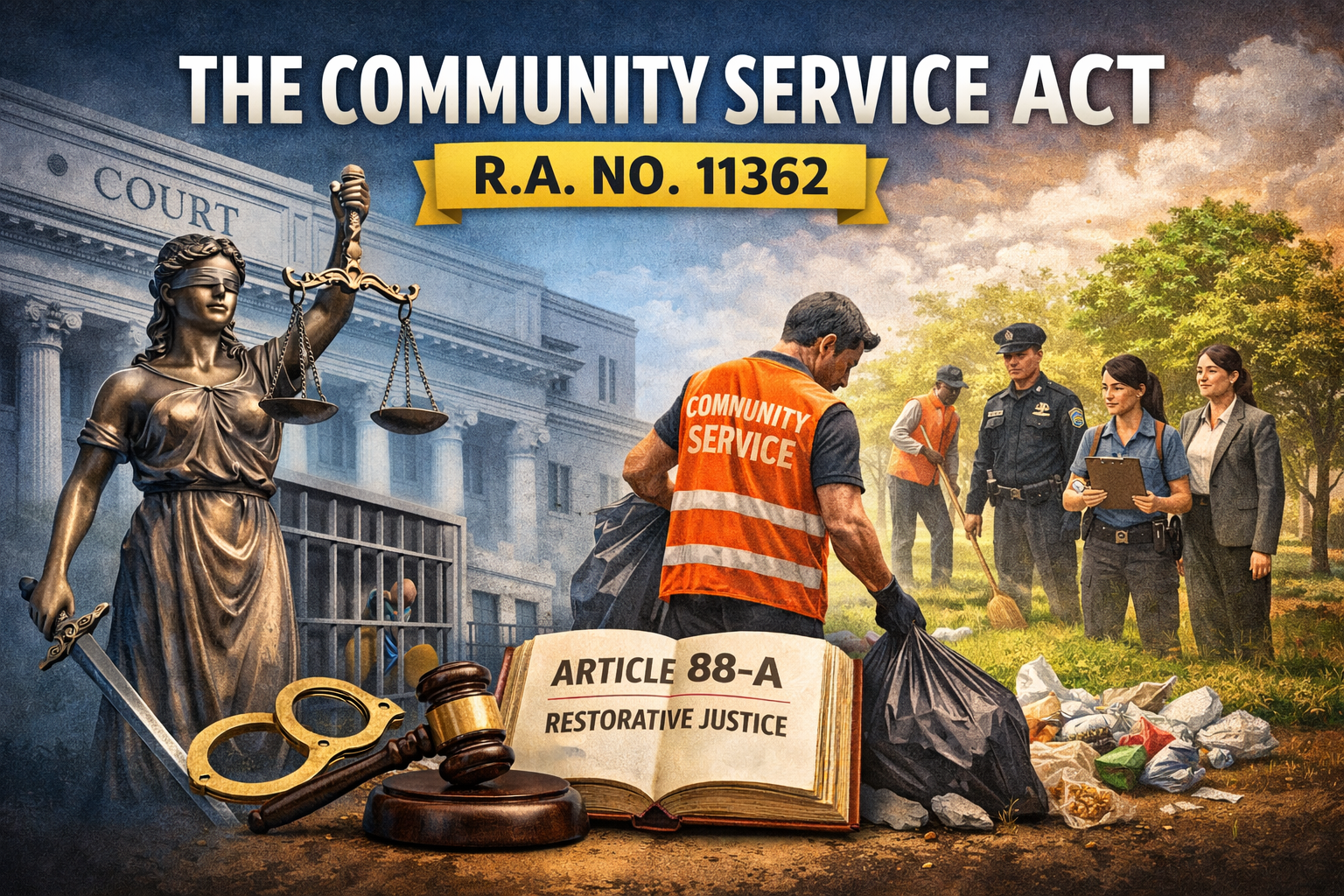
It is against this backdrop that R.A. No. 11362, or the Community Service Act, must be understood. The law introduces a calibrated alternative to short-term imprisonment—one that reflects a shift toward restorative justice while remaining firmly grounded in judicial discretion. Though concise in text, its implications for criminal procedure and sentencing practice are substantial.
This article offers a structured discussion of the law’s key features, its practical operation, and the doctrinal clarifications introduced by recent Supreme Court rulings.
The Statutory Innovation: Article 88-A of the Revised Penal Code
R.A. No. 11362 inserted Article 88-A into the Revised Penal Code, thereby creating a statutory basis for courts to impose community service in lieu of imprisonment.
Community Service. – Article 88a of the Act No. 3815 is hereby inserted to read as follows:
“ART. 88a. Community Service. – The court in the discretion may, in lieu of service in jail, require that the penalties of arresto menor and arresto mayor may be served by the defendant by rendering community service in the place where the crime was committed, under such terms as the court shall determine, taking into consideration the gravity of offense and the circumstances of the case, which shall be under the supervision of a probation officer: Provided, That the court will prepare an order imposing the community service, specifying the number of hours to be worked and the period within which to complete the service. The order is then referred to the assigned probation officer who shall have responsibility of the defendant.
“The defendant shall likewise be required to undergo rehabilitative counseling under the social welfare and development office of the city or municipality concerned with the assistance of the Department of Social Welfare and Development (DSWD). In requiring community service, the court shall consider the welfare of the society and the reasonable probability that the person sentenced shall not violate the law while rendering a public service.
“Community service shall consist of any actual physical activity which inculcates civic consciousness, and is intended towards the improvement of a public work or promotion of a public service.
“If the defendant violates the terms of the community service, the court shall order his/her re-arrest and the defendant shall serve the full term of the penalty, as the case may be, in jail, or in the house of the defendant as provided under Article 88. However, if the defendant has fully complied with the terms of the community service, the court shall order the release of the defendant unless detained for some other offenses.ℒαwρhi৷
“The privilege of rendering community service in lieu of service in jail shall be availed of only once.”1
The innovation is not the removal of criminal liability. The law does not decriminalize offenses punishable by arresto penalties. Rather, it provides courts with an alternative mode of serving sentence, anchored on the policy of restorative justice and jail decongestion.
Under Article 88-A, the court may require the accused to render community service instead of serving time in jail. This formulation is deliberate. It preserves the sentencing authority of the trial court and ensures that the alternative is applied only when justified by the facts of the case.
The Scope: Strictly Limited to Arresto Penalties
The reach of R.A. No. 11362 is deliberately narrow. It applies only when the penalty imposed is:
- Arresto menor, or
- Arresto mayor
This limitation is not incidental. It defines the boundaries of judicial authority under the law.
In practice, this means that before invoking the statute, counsel must determine the final imposable penalty after considering the nature of the offense and any modifying circumstances. If the penalty falls outside arresto menor or arresto mayor, the law does not apply.
The Supreme Court, in Moreno vs. Sandiganbayan,2 emphasized this boundary. It rejected attempts to extend the concept of community service to penalties beyond arresto levels or to transform it into a form of “house arrest.” Courts, the ruling stressed, cannot create sentencing alternatives without statutory basis.
Discretion, Not Entitlement
A central feature of Article 88-A is judicial discretion.
The law provides that the court may require community service. This language unmistakably signals that the remedy is not a matter of right.
In Peña vs. People,3 the Supreme Court reiterated that the grant of community service depends on the court’s evaluation of:
- The gravity of the offense
- The circumstances surrounding its commission
- The welfare of society
The imposition of the penalty of community service is still within the discretion of the court and should not be taken as an unbridled license to commit minor offenses. It is merely a privilege since the offender cannot choose it over imprisonment as a matter of right. Further, in requiring community service, the court shall consider the welfare of the society and the reasonable probability that the person sentenced shall not violate the law while rendering the service.4
The law itself requires the court to determine whether there is a reasonable probability that the offender will not violate the law during the period of community service.
For defense counsel, this means that an application must be supported by concrete indicators of suitability—such as stable residence, employment, community ties, and demonstrated willingness to comply. Community service must be presented not as a convenience, but as a credible rehabilitative option.
The Meaning of Community Service
Article 88-A defines community service as:
“Any actual physical activity which inculcates civic consciousness and is intended towards the improvement of public work or promotion of public service.”
This definition yields several important characteristics:
- It involves real work. The law contemplates actual physical activity, not symbolic participation.
- It serves public benefit. The activity must contribute to public work or public service.
- It promotes civic responsibility. The objective is not merely punishment, but formation.
Equally important is the structure imposed by the law. The court must issue an order specifying:
- The number of hours to be rendered; and
- The period within which the service must be completed.
Supervision is entrusted to a probation officer, underscoring that community service is not informal volunteer work but a court-supervised sentence.
Rehabilitative Counseling as a Mandatory Component
Beyond physical service, the law requires participation in rehabilitative counseling, conducted under the supervision of the local social welfare office with assistance from the DSWD.
This requirement reflects the deeper philosophy of the statute. Accountability is paired with intervention. The goal is not merely to sanction, but to reduce the likelihood of reoffending.
In practice, this component also introduces logistical considerations. Coordination with local agencies becomes essential, and counsel must be mindful of possible constraints in implementation.
Consequences of Non-Compliance
The law does not treat community service lightly.
Failure to comply with its terms carries a clear consequence: re-arrest and service of the full term of imprisonment.
This provision serves as a caution. While community service avoids incarceration, it demands discipline and adherence. Non-compliance effectively nullifies the privilege and restores the original penalty.
Conversely, full compliance entitles the accused to release, provided there is no other lawful cause for detention.
The One-Time Availment Rule
Article 88-A provides that the privilege of community service may be availed of only once.
This limitation reflects a policy choice. The law is intended as a second chance, not a recurring substitute for imprisonment.
For practitioners, this introduces strategic considerations. Where multiple cases are pending, the timing of availment becomes critical. The statute does not comprehensively address all possible scenarios, leaving room for interpretation and, potentially, further judicial clarification.
Retroactive Application: A Favorable Penal Law
In Peña vs. People,5 the Supreme Court held that R.A. No. 11362, being favorable to the accused, may be applied retroactively pursuant to Article 22 of the Revised Penal Code.
Even where judgment was rendered prior to the law’s effectivity, the accused may still seek conversion of the sentence to community service.
The Court also clarified an important procedural safeguard: after promulgation of judgment, the accused must be informed of available options—appeal, probation, or community service. Notably, an appeal bars the application for community service.
Proper Forum: The Court of Origin
Applications for community service must be filed in the trial court that rendered judgment.
In Cafranca vs. People,6 the Supreme Court underscored this procedural rule, aligning it with the principle that sentencing courts are best positioned to evaluate compliance conditions and supervise implementation.
From a practical standpoint, this means that counsel must act promptly and within the proper forum, particularly in light of procedural timelines.
Not a Substitute for “House Arrest”
A recurring misconception must be addressed directly: R.A. No. 11362 does not authorize house arrest.
The law permits community service only within its defined scope and structure. It does not create a general alternative mode of serving imprisonment outside custodial settings.
The Supreme Court’s ruling in Moreno v. Sandiganbayan serves as a clear warning against attempts to expand the statute beyond its terms.
Policy Significance: Restorative Justice in Practice
The Community Service Act represents a measured reform.
From a restorative justice perspective, it shifts the focus from confinement to accountability within the community. Offenders contribute directly to public welfare while maintaining ties to family and employment.
From a systems perspective, it alleviates the burden on detention facilities and reduces the cycle of short-term incarceration.
Yet, its success depends on effective implementation—clear judicial orders, capable supervision, and meaningful compliance.
Practice-Oriented Considerations
For Defense Counsel
- Determine whether the penalty falls within arresto menor or arresto mayor.
- Present community service as a discretionary remedy supported by evidence of suitability.
- Consider the implications of the one-time availment rule.
- File the application promptly in the court of origin.
For Prosecutors
- Evaluate the impact on public welfare and the likelihood of compliance.
- Where appropriate, oppose applications lacking credible basis.
- Ensure that any grant of community service includes clear and enforceable conditions.
Conclusion
R.A. No. 11362 introduces a practical and principled alternative to short-term imprisonment. It does not diminish criminal accountability. Instead, it reframes it—allowing courts to impose a sanction that is both corrective and socially constructive.
The Supreme Court’s recent rulings have clarified its contours: its retroactive application where favorable, its procedural requirements, and its strict limits. These decisions reinforce a central point—the law is a measured tool, not a broad escape from incarceration.
For law students, the statute offers a clear illustration of how legislative policy translates into penal reform. For practitioners, it provides a valuable option—one that must be invoked with precision, supported by facts, and grounded in the limits of the law.
In the end, the Community Service Act stands as a reminder that even within the structure of criminal law, there remains room for measured judgment, proportional response, and the possibility of reform.
Frequently Asked Questions
Who can be ordered to do community service instead of going to jail?
Only defendants sentenced to arresto menor or arresto mayor may be allowed to serve the penalty through community service, and only if the court, in its discretion, grants it.
Can R.A. 11362 still help someone convicted before 2019?
Yes. Because it is a penal law favorable to the accused, its benefits may be applied retroactively (so long as the accused is not a habitual criminal), consistent with Article 22 of the Revised Penal Code as applied by the Supreme Court.
What happens if the person fails to follow the community service terms?
If the defendant violates the terms, the court shall order re-arrest, and the defendant must serve the full term of the penalty in jail (or, as applicable, in the house of the defendant under Article 88). If the defendant fully complies, the court orders release unless detained for another offense.